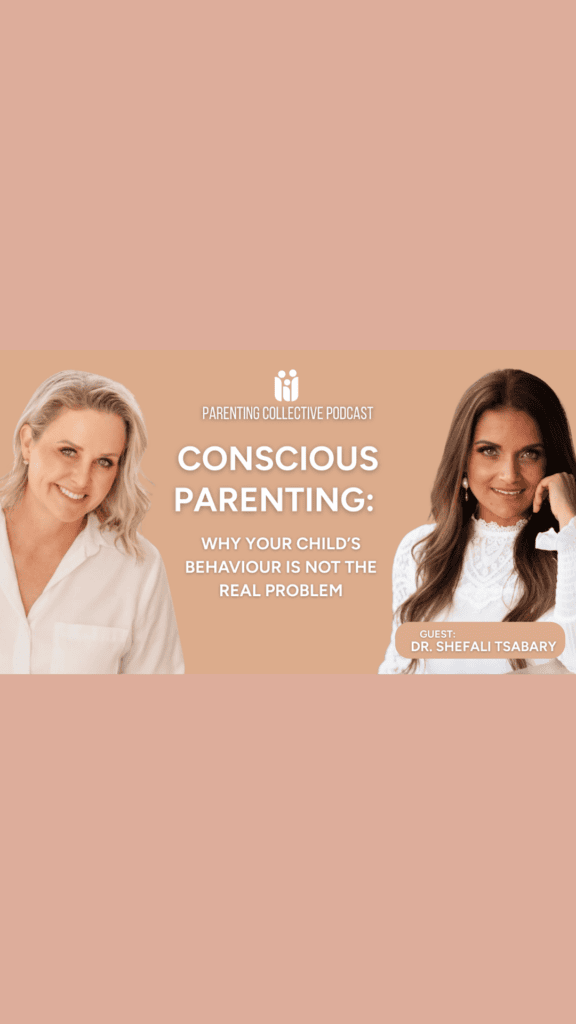
Hello, beautiful people. I am so
excited, more than excited to share this
episode with you. I’m like squealing
inside. This one is extremely special.
And before we begin, uh I want you to
really understand how huge this moment
is for me. Uh this incredible guest has
been interviewed by none other than
Oprah Winfrey, one of my faves, Bnee
Brown, Dr. Gabbor Mate, Jay Shetty,
Steve Bartlett, Diary of CEO, loving
that at the moment. Mel Robbins, and the
list goes on and on. and she is who I’ve
been certified with to become a
conscious parenting coach. So who is it
you ask? It’s none other than Dr.
Shafali. She is a New York Times
bestselling author many times over,
worldrenowned clinical psychologist and
the pioneer of conscious parenting. So
her work has completely changed the way
we understand children behavior and most
importantly ourselves as parents and her
teachers are actually really woven
through everything I share inside
parenting collective. And the timing is
perfect because Dr. Shafali is coming to
Uh I’m going to go and see her and give
a big hug in Sydney. So Sydney and
Melbourne in March. Uh which makes this
conversation feel even more powerful and
timely here in Australia. So here is the
incredible Dr. Shafali. Hope you love it
just as much as we did. Hello Dr.
Shafali and welcome to the Parenting
I’m so excited to be here.
Oh my goodness. I’m just I’m so
generally grateful and honored to have
you here today cuz as we just discussed
I completed the conscious parenting
certification through your institute in
cohort 10 which I was thinking I can’t
even remember I think it’s two years ago
you and your work has deeply shaped the
way that I have supported not only my
family but all the families around the
world that I work with people that
listen along know that I’m obsessed with
sleep and mental health and all of those
things but conscious parenting is my new
passion so to sit here with you woman
towoman mother to mother feels really
incredibly special. So, thank you.
Oh my god, thank you. And I know you
really have learned so much from the
coaching institute and I see it in your
work. And for anyone listening who’s
curious to become a coach and they
contact you, I will give them a $500
Oh, well, thank you. That’s exciting.
for your people because we have two two
cohorts every year as you know
and they’re 5 months each and they’re
very intensive as you know and hands on
and they really teach you
how to be a a coach for yourself, how to
become a conscious parent yourself and
as a career as a purpose as a passion.
And you are Yeah. an incredible mentor
and teacher. I just learned I feel like
I’ve always been someone who has dug
deep for the last 30 years to heal and
grow and you know figure out myself but
this was just such a pivotal intensive
six months because the way that you view
things in life I’ve never come across it
before but it’s a very grounded
conscious aware way of thinking of life
so it is conscious parenting for sure
but it’s also conscious living with
relationships you know families friends
and stuff it really does change your
yeah it it really does and The
consciousness piece is what is typically
missing out of most parenting books or
out of most certifications. And what is
that consciousness piece that I teach?
It’s really it’s inspired from Eastern
uh which is completely imbued with
mindfulness and presence. So I’m
teaching you to not only understand
psychology of your child, psychology of
yourself, but I’m teaching you
mindfulness techniques to manage your
Whereas a typical psychologist or a
typical coach would just do it in a kind
of more behavioral way, but I’m teaching
you mindfulness techniques. Because when
you employ mindfulness and consciousness
and you raise yourself, you win two
ways. One, your life changes. You
evolve, but you also manage your child’s
stressful situations in the most
that allows them to connect and evolve.
Right? Most people want to manage
so that the problem is fixed.
Yep. conscious parenting what I teach
and I’m coming to Australia. I’m so
excited. I know I’m going to be teaching
people I’m going to be teaching people
how to help children to evolve.
To not fix their problems. We want to
teach them to regulate to evolve.
And that’s what conscious parenting
Absolutely. And you know what? I haven’t
even asked you the question yet, but I
will be a bit more specific because you
just did explain it absolutely
beautifully for myself. I think
everybody but for the people that are
listening and have never heard of the
term conscious parenting or you know
that brand new to the conscious
parenting you did just explain that but
in more simple terms for someone who’s
never heard of conscious parenting is
there a sentence or a paragraph that you
could be very specific with that because
yes you did explain that but I think
like it’s a bit permissive or gentle or
you know all of those things but more
direct to someone who’s never heard the
right conscious parenting is when the
parent becomes conscious of how they are
impacting what they experience with
So it’s about raising yourself as you’re
raising your child. So whatever you’re
seeing with your child, the child’s
tantrum, the child is defied, the child
The conscious parenting modality, the
approach teaches you how to understand
how you are interpreting that in a way
that actually doesn’t serve you or serve
them. And the way that you’re
interpreting them that moment is based
on your story, is based on your past.
And the minute you realize that,
right, it’s liberation because you you
begin to realize, wow, I was totally
going down the hill thinking my child
was X and my child was lop.
It’s completely different. But I had no
way to I was convinced they were X. And
and when I teach parents this, and I’m
they the the aha, you know, moment
occurs and then the light bulbs go off
and the the way they interact with their
children, it’s a game changer.
Completely. And like I was saying before
before we started, the way the why I
chose you to do my certification is you
are the pioneer and founder of the
conscious parenting movement. you have
had a PhD and a doctorate at Columbia
University as a psychologist. Yes. So,
lots and lots and lots of training and
training and working in that space. Um,
but through the cohort, one of the
things that you said is that there was a
gap, you know, like you were seeing
families and you were seeing things
happening. You were like, you know, and
with your own daughter Maya, things were
happening as she was growing and you
were like, this is not A’s is not
working and why is not A working and I’m
making her try to do A. Um but where or
c can you sort of reflect on those times
where you thought there’s a gap that we
need to look at that made you evolve
into becoming the pioneer for the
Yeah. So I was studying psychology doing
the textbook work in these ivory tower
institutions and it just wasn’t working.
Like you said it would work momentarily
and I could kind of fix the behavior but
I didn’t feel good. I felt like I was a
control freak. I felt like I was power
tripping my daughter. It did not feel
So I had to really meditate and look
I developed conscious parenting really
out of my own pain that nothing was
and it really came out of my own
spiritual awakening. So conscious
parenting and people tell me this when
they read my books is that they feel
like it’s an inspired work, right? They
feel like it it like rings with light.
Yeah. With light bulb moment because it
rings with a resonance and a truth that
approaches can ring. And and you and I
Always. Always. Always. And a little bit
of a backstory for our listeners and and
people that listen to me um have heard
this before, but hopefully lots of new
listeners when they hear this. I have
three teenage daughters or we have three
teenage daughters, 20 um 18 and 14. Holy
moly, you’ve got one. It’s a lot. One’s
a lot. Um I listen podcast with Maya the
other day and I was like because Mad’s
very strong willed ve like very strong
willed and like you said the traditional
authoritarian like do as I say why
you’re not doing that didn’t work and so
you as a human and a mom went I need to
change this. So with the three girls,
easygoing, all of that stuff. We
thought, “Oh, parenting, easy peasy.”
Middle one came out with their middle
you know, and so we were like, “Oh,
that’s not working.” So, not until like
early teens um did we start to see this
real defiance and it destroyed her, it
destroyed our family. Um, and long story
short, that family counseling, so all
together and that really looking in
inwards to us, which again, it’s not
blame and guilt to the parent. It’s
like, oh, we have those expectations.
Oh, we’ve made her feel like the black
sheep. Oh, you know, cuz we love her.
And then that realization so over the
last 5 years and now training with you
and now on the other side. And you’d be
the same with Maya. so proud, strong,
big voices, know what they want,
actually are right quite often. And we
had to learn to adjust to that. And
that’s very uncomfortable at times,
Yes. And you you hit the nail on the
head because this approach sounds like
that it’s always a parent’s fault,
right? Because we’re we’re asking the
parent to look at themselves and then
the parent begins to feel guilty and
ashamed and embarrassed and defensive.
But this is not about blame or guilt.
This is about understanding that you
that you’re actually giving away by
thinking it’s just the child.
Actually, when you see your co-creation,
you realize, oh my goodness, I can do
something. I can do something to change
And this is what conscious parenting
does and this is what I teach.
Oh my gosh. Exactly. Because one of the
questions that I had for you and I spoke
to my husband about this because he is
Aussie Aussie you know they are well
tough men that they’ve been brought up
to not cry you know it’s hard for them
you know he’s 52 so that generation’s
really tough because you know he’s high
highly successful physiootherapist has a
really great life so he’s thinking you
know we need to parent like my parents
did so beautiful him and his soft heart
strong man over these years really had
to go against all of his instincts and
his generational patent instincts and
against family and thing people that
were saying you’re ruining her. Um, and
his question was is how could you
explain to people listening to this or
fathers here in Australia that are lost,
their children and their relationship
aren’t working. They have been brought
up with, you know, authoritarian do as I
say and they’re in this no man’s land
where this daughter or child is talking
rudely, disrespectful. Where would they
start to be able to understand that it’s
not permissive? It’s not giving into the
child. It’s it’s working with that
connection and mentoring for a better
relationship. Does that is that
Well, the best way to to begin with
parents who are very closed is to remind
them of their experience as a child.
So, ask them for a painful traumatic
moment or memory from their childhood.
And they will say when my father
dismissed me, when my mother didn’t
appreciate me, when my father rejected
me. And you take them back to that
moment and you ask them to re to reflect
and ask them what do they wish their
And then you ask them, are you doing
this in your current life?
Right. Or what would your child wish you
Yeah. And and we teach these parents
that behavior is always a scream for
help, right? So if it’s negative
behavior, it’s a scream for help.
So what is the inner need? What is the
need beneath the behavior? And this is
what parents miss all the time.
Because parents only go for the
There is something beneath the behavior.
So if the child is sitting on the couch
and we just look at the behavior we see
laziness, unmotivation, procrastination
But if we understand psychology, we
understand that this this kind of apathy
and listlessness has come from repeated
shame has come from repeated rejection.
Now if you understand that then I teach
you how to handle the inner need,
right? I always talk about what is the
and if you are not trained to do this
then you’re going to miss the inner need
the connection which is the only thing
if you ask any human being on their
deathbed what was the most important
thing for you that person will say my my
what they mean is their connection
and what kind of connections are
valuable the ones where we feel seen
where We feel understood at our depth
where we feel unconditionally accepted.
Yeah. And we cannot do any of this if we
don’t come to this with a high level of
And in my approach, I teach people. I
cultivate this. I train them to have
this higher level evolved consciousness.
You do. And I feel like I’m one of your
minions. Is that a good thing or a bad
thing? You know, like, you know, I just
I just Yeah. And and it gives me
goosebumps because we were in the depths
of such darkness for years and no one
understood in particular like I said in
Australia and we had this family um
counseling which is what people don’t
understand it was good too because the
dynamics of the child seeing our
generational patterns and often them
softening us because it was so hard and
and we wanted to fix this behavior and
one time when it was at its worst so
15year-old really struggling with
anxiety um fightlight response but the
fight response response, which is tough.
Uh, and then we wanted to keep fixing it
and she kept biting. Um, and the
counselors went, you need to let go of
the res. And I we pardon pardon. But
what she was saying in a conscious
awareness way is and explained you you
lead by example. You say connected when
they’re very hard to be connected with.
So it’s us adults with the frontal
cortex, which they don’t have children.
We have to be it and guide them through
it, you know, and and understanding the
light at the end of the tunnel is this
is connection. The child is strong,
independent and off on their own, which
is good, but you have a relationship
where they can come back and feel safe.
You know, that’s the biggest thing about
conscious parenting is being their
Absolutely. Because safety, soothing, a
feeling of significance. This is what
every human wants to be seen, to be
understood. Do I matter? and they need
somebody to believe in them because they
don’t have that prefrontal cortex yet.
So you are their outer nervous system
because their internal nervous system is
is still unregulated. It’s it’s it’s im
So in conscious parenting that’s why
mindfulness is so important because in
conscious parenting you are developing
your own nervous system skills
and you’re you’re honing your
mindfulness. is staying calm so that
your child can borrow from your nervous
If you don’t have a good but if you
don’t have a nervous system well if your
nervous system is is shot if it’s fried
then then you are going to be
and this is what happened. Yeah.
Totally. And and this is why with lived
experience is that that’s what happened.
I was over sensitized. I was nearly
feeling like I was have a nervous
breakdown. my husband would go to anger
because we were we lost that feeling of
control which again control is not the
right thing to say is it it’s like
mentoring and and educating and
supporting them through but we if we
have done this and it works then we need
to tell the world and now you know I
have this platform that I can and so I
work from newborns to 10 year olds to 18
year olds and you know we get in early
toddler’s ears then you know hopefully
um one by one we’ll change change the
world well in Australia will definitely
right and even if you are listening to
this and you’re thinking, “Oh my god, my
kid is 21 years old. Nothing’s going to
You can begin to change right now.
Like it it just takes intention. It
takes work. But which side do you want
to stand on? Do you want to you want to
just find it easy, but then you won’t be
connected. If you want to be connected,
you have to do the difficult work. So
where do you want to stand? But no age
is too late. Now, of course, there is
this this invaluable window till they
are 17 18 where they’re very plastic and
they can be maneuvered and you can you
can be flexible with them. But the
relationship can change at any point at
Yeah. And with all the learning and
continuing to learning to the last day
on earth, I would say I use it with
relationships, you know, with friends
and parents and you know, you’re myself.
It’s mostly myself. That’s totally
motherhood obviously changes us in like
nothing else. We know that. So, how did
becoming a mom to your daughter Maya
sort of open up you and challenge you in
the ways that that has shaped your work?
Oh, in every way she still does even
though she’s 22 because in every way,
you know, I I now am seasoned enough to
to try different ways to pivot. Um, but
at every moment I’m trying to be
effective and conscious, right? That
that’s the the the the amazing duo. You
you want to be effective and you want to
because sometimes you can be effective
and slap a kid and they could wake up
like they could correct [clears throat]
their behavior, but that’s not
You want to be effective and conscious.
Right. So you want to be as kind and
compassionate, but you have to be
effective. So, you know, I I have just
been transformed at every level to
evolve to to notice where I am falling
into my habits of fear and anxiety of
wanting to be a people pleaser, not
being able to create a boundary
and and really whenever I step up to
create a conscious boundary.
Whenever I step up to enter
unconditional acceptance, it always
Yeah. Yeah. So, so the missing piece is
and when I’m not aligned then I will not
be able to do this well. And I tell this
to all parents, you know, you want your
child to be an adult. You want your
child to, you know, be resilient, but
you don’t let them make any mistakes.
I know. And it’s getting worse. We’re
And every time they make a mistake, you
screaming at them. But yet it is only by
that they can develop the skills to
Totally. And it’s hard as a parent to
allow that to happen. I think that it
comes back to us conscious awareness of
what we’re feeling and and having the
the girls that they’re driving and going
out and traveling. It’s like I have to
consciously allow the universe. It’s
going to be fine. But it’s consciously
not putting the lid on that and letting
them learn and live, you know, but come
Yeah. And of course, of course, we don’t
let them run out into the street. No,
but we we look at those hard knocks as a
powerful force in our children’s lives.
yes, we can try to help them. Yes, we
can try to protect them. But when the
hard knocks happen, which they will,
no matter how much we protect our
children, when they happen and your
child is crying and, you know, cannot
breathe and they they’re heartbroken
because they got their first rejection
or they didn’t get into the school they
wanted or they didn’t get the job. Look
these are building my child’s muscles of
resilience. Ah as as much as you want to
scream oh my gosh you want to fix
everything you have to say this
totally and you know for me again lived
experience you know and I talk about
this a lot. eldest had a really tough
time and was suicidal and you know
really awful with that journey
but a lot of it even when we were at
hospital I would just say that I would
just say this is happening for a reason
it has to be you know she’s okay she’s
here so if we’ve gone through the
toughest times and thankfully she’s
still here and and this conscious
awareness of like ah to be that down and
so thankful that she’s here to really
believe in conscious parenting that this
is okay we’re learning through this so
now you we’re doing interviews and she’s
helping people and so I’m not wanting or
wishing that for anyone that was really
terrible but on any times that you feel
that are challenging with your children
exactly that Dr. Shapali is like sitting
there surrendering to it a bit and
thinking okay this is a lesson we need
to have and we’d have to go on about it
to them but be that strong sort of
mentor for them and then talk through it
as they get a bit better and so on the
other side of that that’s exactly what’s
happened she can talk openly I’m glad it
happened when she was at home and I
think the more connected we are as
parents consciously then [clears throat]
when the world lets them down as it will
we can we can be those that soft landing
yeah and and all of this takes
us managing our own inner fears and our
own inner anxiety and those inner fears
and anxieties come from our childhood
and that’s why I say conscious parenting
as much as it is raising our children
totally totally totally totally totally
and I could speak to you for days but
it’s late for you and um you know to
head off but I am so excited and well
again so grateful to have you and and
one-on-one with you I’m eternally
grateful I truly But to finish off,
thrilled to share, as we talked about,
that you are coming to Australia in
March, early March, Sydney and
Melbourne. I will be heading to the
Sydney. I’ve got my VIP ticket, so I’ll
be able to give you a hug. Um, and can’t
wait obviously to see you in person. So,
for those that are listening and the
more that I’m going to talk about
conscious parenting here, what would
they expect when they come to some of
these events, you know, um, in a bit of
Yeah. So there’s going to be uh
hopefully a lot of real life examples of
what to do and what not to do. And
parents will definitely leave extremely
inspired and with a whole new
on how they can change their
relationship with their children, how
they can improve it, how they can pivot
it, how how to see children in a
different way. And you know, there’s
never been a parent who’s left my talk
who at least hasn’t been transformed.
It’s it’s another thing if they use the
techniques, if they ever can apply them,
moved and inspired to think about this
And everyone is coming with love. You
know, when I think of the toughest
times, it’s all we’re it’s love and
fear. So, it’s like everyone would come
to your show for the love of their
child, you know, like even if things are
struggling at home, but the thing is for
you, and again, it’ll be it was in the
show notes before, and it’ll be
underneath the podcast, you have
brilliant books. You know, you’re a New
York bestseller in regards to this way
of living, not just just as parents, but
as yourself, as a relationship. So,
people to come to these events will be
spectacular to see you live. But you
have incredible books, literally like
it’s called the parenting map. Parenting
map. can’t remember what it’s called
because I’ve got it ear tagged. Um, but
it’ll be truly a map of like how do we
implement this in our lives.
Yes. Yes. I’ve written seven books,
writing two more, uh, which are going to
come out next year. And actually, I’ll
be talking about those two books in
particular because they focus on raising
Gen Z and alpha children, the children
that are right now growing up in the
modern tech era and what are the unique
issues that we’re seeing and how we can
combat them as well. So, it’s going to
be focused on conscious parenting. It’s
going to be focused on new skills and
how we can deal with the digital era.
Oh, which everybody needs.
So, thank you so much again and I will
see you in Sydney and um looking forward
Thank you. Thank you. And if anyone
wants to explore my coaching institute,
which Donna has been to, she is one of
my coaches. Uh they should hit you up
for the 500 coupon. And I hope I see
your listeners in Sydney or Melbourne.
It’s it’s a different experience when
and you are you are with other parents.
It’s very moving. It’s very
It absolutely. So yes, I and everything
will be in the show notes as well. So
thank you so much for your time. I know
how busy you are. We’ll see you soon.
So if you enjoyed this episode, be sure
to leave me a rating and review. I love
reading all of your messages. So shoot
me a DM over on Instagram. It is
I also offer a free 15-minute no
obligation phone chat. If you’d like to
book one, head over to my website
www.paringcollective.com.au
and request one there. So, try to
remember to be kind to yourself and
always know you’re doing the best you
can every day, no matter what your day
is looking like. Until next time, much