<ul>
  <li>
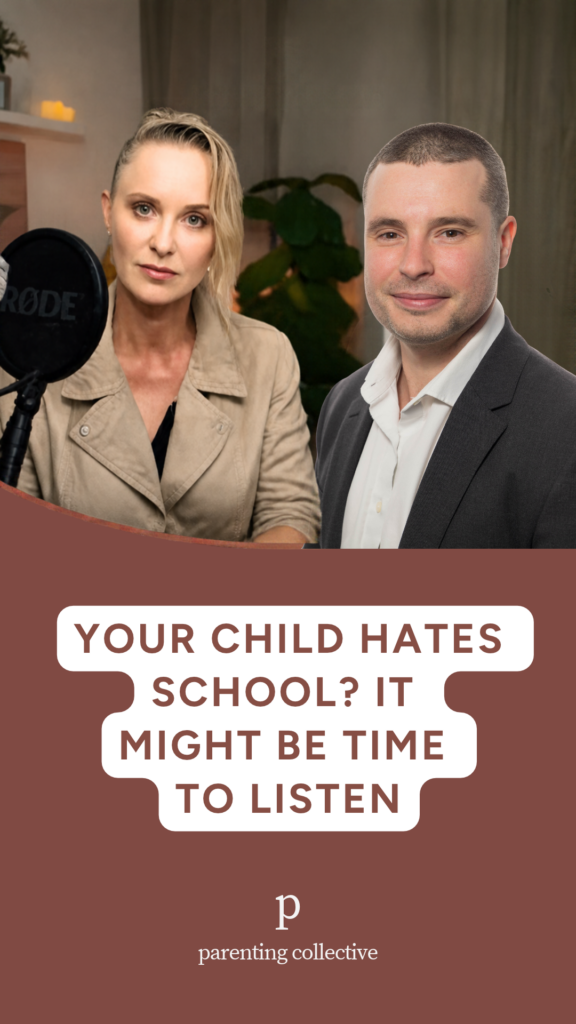
    <p><strong>DONNA MOALA</strong> — Hello and welcome to this week's episode. So this week, always excited as we know. I am joined by Alexander Cork from Crimson Global Academy and I'm really looking forward to this conversation because as parents, many of us grew up believing there was only one path when it came to education, traditional education that still has not really changed over the last hundred years. You went to school, you followed a curriculum, and hopefully found your way through it.</p>

    <p>You know, teachers are all doing the best they can. And teachers are just worth their weight in gold. But they are really struggling in this day and age trying to support kids in this generation. But for many families today, particularly those navigating school around anxiety, neurodiversity, learning difficulties or simply a child who is just not thriving in that traditional classroom, parents are beginning to ask whether there might be another way.</p>

    <p>What is there? Is there just homeschooling? What other way can we do this that's not just me doing the homeschooling? So Alexander is passionate about helping families explore what education can actually look like when the learning is built around the child rather than expecting every child to fit into the same system.</p>

    <p>Through his work with Crimson Global Academy, he's supported families from around the world who are looking for flexible and personalised approaches to education while still maintaining strong academic outcomes for their child. Today we're diving into alternative education, school anxiety, online learning and what parents can do when they know something just isn't quite working for their child, but they're not sure where to turn next. So I hope you enjoy this conversation as much as we did.</p>

    <p>It has really opened my eyes in regards to an alternative to traditional schooling. We'd love to hear comments. Let me know your thoughts and speak to you next week. Morning, Alexander, and welcome to Parenting Collective.</p>
  </li>

  <li>
    <p><strong>ALEXANDER CORK</strong> — Thanks very much, Donna. It's great to be here with you.</p>
  </li>

  <li>
    <p><strong>DONNA MOALA</strong> — We were just getting to know each other a little bit and the conversation was so good I had to pause and we had to record it because this is what I want to share with the listeners, all of your information around what you do. So if you could share with the listeners who you work with and what you do for families out there.</p>
  </li>

  <li>
    <p><strong>ALEXANDER CORK</strong> — Yeah. So I'm head of admissions for an online school. The school's called Crimson Global Academy. The shorthand is CGA.</p>

    <p>And I've been at the school for three or four years now. I've been at the wider umbrella company, which is Crimson Education, for 10 years. At CGA, we were initially created to help gifted kids and kids who wanted to go to top US and UK universities because that's on brand for Crimson Education. That's what they specialise in, US and UK admissions.</p>

    <p>But the reality has been very different. The audience that has been coming to us over the last three or four years has been a lot of students who don't fit into traditional schooling models for various reasons. Some of them are those push factors, you know, they just don't have time for physical school anymore because they are an aspiring ballet dancer, for example, and they're training ridiculous hours or they're an athlete that trains ridiculous hours. Or they're a student who travels with their family quite a lot.</p>

    <p>Their family moves for work and they have to move school every five minutes or they just have the lifestyle of travelling quite a lot. That's what they want to do. A lot of those families come to us and it's not necessarily an urgent request of, “Hey, we need to move school ASAP.” It's more like, “Oh, this is something we're thinking about and would like to do in future.”</p>

    <p>But then on the other hand, you've got this whole pool of families that are termed now accidental homeschoolers. And I think it's a really great phrase, right?</p>
  </li>

  <li>
    <p><strong>DONNA MOALA</strong> — Exactly. Oh my gosh.</p>
  </li>

  <li>
    <p><strong>ALEXANDER CORK</strong> — And there's been quite a few stories about it. I think increasingly families are aware that this is a category that they themselves are fitting into. Some families come and say, “Oh, we are essentially accidental homeschoolers. We never had the intention of going down this route, but circumstances the way they are, we need to homeschool.”</p>

    <p>And I guess from our perspective, we are probably the most school-like homeschool option. We are actually a registered school in New Zealand. We are a registered school in the US, but in Australia, because of the state-based system and all the rest of it, we're not yet an Australian registered school because I guess there is no such thing as Australian registered. You have to go state by state. It's a whole mess.</p>

    <p>But anyway, families use us as part or all of their homeschool plan here in Australia and then use the qualifications that their children earn in order to go to university. The school that we offer has the principal and the deputy principal and has exams and assessments and competitions and all. So it's very much like a private school.</p>

    <p>And it's really interesting, in Australia the concept of private online schooling or even online schooling for so long has been distance, farmer families type of thing. That's been the done thing for distance education, government-run programs, etcetera. But there were very few private schools that had an online offering. You look at the US and European markets, they are light years ahead of Australia and New Zealand in terms of this offering.</p>

    <p>They've got some fantastic schools. Some of the best schools in the US are online schools in terms of their results and everything else. So we're playing a bit of the catch-up game here in Australia and New Zealand, and really just trying to show families that this type of school exists.</p>

    <p>And then also really trying to break the mould in terms of how much flexibility the online space has. We have this part-time option where families can join for one or two subjects or we have the full-time option. Of course, we have one-to-one classes, we have group classes, we have students from 60-plus countries and all these types of things. So yes, we're a traditional school in many ways, but very different in many others.</p>

    <p>But certainly, it's really been interesting to see a lot of these families who have been pushed out of traditional schooling due to mental health, bullying, medical needs, I would say. A lot of the kids that we meet at the moment are neurodiverse and they just are falling through the cracks and all these types of things. So it's nice to be able to offer those families a school that supports their child and supports the parent.</p>

    <p>A lot of the time I say to parents, “How's this journey been for you?” And it's as hard for them as it is for their kid.</p>
  </li>

  <li>
    <p><strong>DONNA MOALA</strong> — That's right.</p>
  </li>

  <li>
    <p><strong>ALEXANDER CORK</strong> — Yeah. Exactly. So they're looking for some support too, just as much as their kids are. And we're just trying to do the best we can and fill this gap that is obviously there.</p>

    <p>We see a lot of parents who are like, “I wish this was around when my kid was starting school,” or, “I wish this was around when I was at school,” or, “I didn't even know.”</p>
  </li>

  <li>
    <p><strong>DONNA MOALA</strong> — I just didn't know it existed. I really didn't. And like I was saying to you, the trouble that we went through as a family was really traumatic because our eldest is 21. So that's not that old.</p>

    <p>But you didn't talk about ADD. She was embarrassed about it, you know, it's not even that long ago, and on that journey we felt very solo. And look, in the long run, it's worked out okay. They went to private schooling and it's a great school, but it's not equipped for neurodiverse kiddos.</p>

    <p>I don't even know what the statistics are now. But just in my little Donna world, my 21-year-old didn't want to talk about ADD. No one talked about it. To now, it's really talked about and I think it's a good thing.</p>

    <p>It can be a negative thing, but the neurodiverse or neurospicy kiddos, as we talk about, with all these different levels are, like you said, a square peg in a round hole. They are spectacular. Their brains are spectacular. They're highly intelligent.</p>

    <p>But you get them to go to school and read a book about, I don't know, mountains, they're not interested in it. They're not going to read that book. So people don't understand neurodiverse brains. They can do lots of things at once and they can hyperfocus, but they need to be able to have that perfect support for their brain to learn and they can be anything. So it sounds like this academy would very much be exactly what these kids might need.</p>
  </li>

  <li>
    <p><strong>ALEXANDER CORK</strong> — Yeah, it is. Look, I'm not going to say we're a silver bullet for every family and every single kid, but I think it's really important to see that there are a lot of schools that have created these support programs outside of their traditional classroom. You've got your traditional classroom with 25, 26 kids or whatever it is, and then outside of that you've got your learning support, your academic enrichment programs, selective classes, streaming classes, all these types of things.</p>

    <p>Which are really trying to cater to students who are either one or two standard deviations above or one or two standard deviations below the norm, or students who just learn in different ways or need different conditions to learn. Schools are trying to create this wider net for these kids. And I will say some schools do it super well and some kids are really supported by that wider net and that's fine.</p>

    <p>But then I think sometimes a school needs to know when they are not the best fit. I'll give you an example. There was a family I spoke to just a week ago. Incredibly anxious kid, general anxiety disorder, social anxiety disorder, just really struggling.</p>

    <p>And the school said, “Hey, we're going to have our counsellor meet you at the front gate and we'll try and take a couple of steps into the school. And if we get into the front doors of the school, amazing. We've had a win for that day. But if you get to the front gates and you want to run back home, that's fine.”</p>

    <p>And the parents were going through this with their kid for over three or four weeks. Run, gate, couple of steps, run back. Run, gate, couple of steps. And I would have said, as a parent, but certainly as an educator, “Hey, have you thought about homeschooling for a while? Have you thought about—”</p>
  </li>

  <li>
    <p><strong>DONNA MOALA</strong> — I just really don't think people know that something like this exists. I know you're in it and you've been in it for four years and you're like, “Oh my goodness.” But I've never heard.</p>
  </li>

  <li>
    <p><strong>ALEXANDER CORK</strong> — Yeah. I think a lot of people just don't know. I think a lot of people still associate homeschooling in Australia with parent-led teaching.</p>
  </li>

  <li>
    <p><strong>DONNA MOALA</strong> — Absolutely. Absolutely what I would think, and anyone I speak to. I work with lots of parents and that's the biggest fear. Even for us, when we went through everything, we definitely were looking at different options, Montessori and different schools or whatever.</p>

    <p>But there was not an option for me to be able to teach my child, even if it was led. I just don't think that dynamic in my family would have been successful, to leave it up to the parent. Again, everybody I'm speaking to wouldn't know something like this exists. So it just needs to be known, really.</p>
  </li>

  <li>
    <p><strong>ALEXANDER CORK</strong> — I agree. I think the states in Australia kind of make the homeschool process deliberately difficult because they would prefer students to stay in a school environment. But I think that's not a good fit for a lot of kids. They would prefer to be homeschooled.</p>

    <p>They are often disruptive to the kids who are at school. We see some students who have some behavioural issues and everything, who just are not enjoying school and are really acting out. They just need to have a safer environment at home for a little while. I see a lot of questions on the Homeschool Australia page of parents being like, “I'm new to homeschooling. What do I do?”</p>
  </li>

  <li>
    <p><strong>DONNA MOALA</strong> — Yeah, totally. I have no idea where to start.</p>
  </li>

  <li>
    <p><strong>ALEXANDER CORK</strong> — Yeah. And it's interesting as well, the amount of queries that we receive that are either parent-led or student-led. I see a lot of the queries increasingly being student-led. Or the students saying to their mum or dad, “I don't want to go to school anymore.”</p>

    <p>“I want to online school or I want to homeschool. I want to do this and that, or I just don't want to go to school anymore.” I was talking to my mum and my mum said, “Oh, school refusal has become such a thing.” And that's how my mum talks a little bit.</p>
  </li>

  <li>
    <p><strong>DONNA MOALA</strong> — Oh yes, of course. Sorry to all the mums out there.</p>
  </li>

  <li>
    <p><strong>ALEXANDER CORK</strong> — But it's that idea that students know that school refusal is a thing now. People are like, “Why is school refusal increasing so much?” Well, I'll tell you why. Because kids are aware that that's an option for them. They don't have to go to school.</p>
  </li>

  <li>
    <p><strong>DONNA MOALA</strong> — They don't. And you know what? The oldies, look, I'm old anyway, but I'm in it. I keep saying, working with parents for the last 10 years.</p>

    <p>So I'm evolving with them even though my kids have got bigger. I can compare five, six years ago, then my own childhood, how easy it was to parent. There was a phone on the wall, no distractions, news at six o'clock at night on TV, Fat Cat when you went to bed. So we didn't know any different.</p>

    <p>So we had to and were made to do what our parents told us to. But our children these days just know too much and it has destroyed so many things. But it can also be a really big benefit to listen more. Like, listen, what do they say?</p>

    <p>Because that's the biggest thing. I'm a conscious parenting coach as well and that just means actually being aware. It's not anything airy-fairy, totally gentle. It's being aware and conscious.</p>

    <p>What's my 14-year-old saying? Okay, you're not going to be permissive and like, “Oh, poor child. You don't need to go to school.” Okay, these are the options.</p>

    <p>What are we going to look at? What are you thinking? Rather than the old school of us was like, “Do it. Just do it. And stop whinging about it.”</p>
  </li>

  <li>
    <p><strong>ALEXANDER CORK</strong> — Exactly. And just do it.</p>
  </li>

  <li>
    <p><strong>DONNA MOALA</strong> — Yeah. Kids these days just know too much.</p>
  </li>

  <li>
    <p><strong>ALEXANDER CORK</strong> — Definitely in a good way. I would say for the kids who come to us, it's definitely a good thing. The students know that the environment that they've got at school is no longer going to work for them. And I always say to parents who come to us and they have this accidental homeschooling type thing, you can feel the sense of defeat that they've got in their voice.</p>
  </li>

  <li>
    <p><strong>DONNA MOALA</strong> — Because everyone judges. Everyone judges, questions. It happens all the time. So to go out on a limb, which sounds amazing and what people need, but it's not run-of-the-mill.</p>
  </li>

  <li>
    <p><strong>ALEXANDER CORK</strong> — Not widely accepted yet.</p>
  </li>

  <li>
    <p><strong>DONNA MOALA</strong> — Yeah. Not widely accepted yet.</p>
  </li>

  <li>
    <p><strong>ALEXANDER CORK</strong> — But I say to parents, “I can hear the tone of your voice. You feel like you failed your kid.” But I try and lift parents up in that conversation and say, “Hey, the fact that you're talking to me when you never thought that you'd probably be talking to someone like me in an online school type of thing shows that you're listening to your kid. That you're trying to do the best by them.”</p>
  </li>

  <li>
    <p><strong>DONNA MOALA</strong> — Absolutely.</p>
  </li>

  <li>
    <p><strong>ALEXANDER CORK</strong> — The worst thing you can do, and this is to all the listeners out there, is if your kid is consistently not enjoying school and is not having a good experience there, not getting academic progress out of that school, whatever, is to continue to drop them off at the front gates and hope for things to change. It's not going to. Hope is not a strategy.</p>
  </li>

  <li>
    <p><strong>DONNA MOALA</strong> — Hope is not a strategy. It's not a phase.</p>
  </li>

  <li>
    <p><strong>ALEXANDER CORK</strong> — Yeah, I know. And some parents, “Maybe it's just a phase.” And I get it because homeschooling is not just a change for the child, it's a change for the parents too. It might mean someone has to reduce their days in office or it might mean constant supervision at home, or it opens this Pandora's box of, “How do I even apply for homeschool?”</p>

    <p>Which I totally get. It's a scary thing. But to continue to send your kid to the front gate to these schools that they're not enjoying, no, it's not going to improve anytime soon. I haven't seen a student or a family—</p>
  </li>

  <li>
    <p><strong>DONNA MOALA</strong> — Absolutely not.</p>
  </li>

  <li>
    <p><strong>ALEXANDER CORK</strong> — After dropping them off for another three months, things miraculously improved. No. It's very, very rare.</p>
  </li>

  <li>
    <p><strong>DONNA MOALA</strong> — The thing is, I don't always want to go into the negative, but I do like sharing lived experiences. That's what I talk about in my stories and my podcast, living it with children that had anxiety and the eldest being severely depressed, suicidal, all of those things. I'm not saying to whoever's listening that that's going to happen to your child. But when you get sucker-punched that the child will not go to school and you're trying to keep your child alive, that's not dramatic.</p>

    <p>But if you take it back quite a bit, anxiety and depression, what's the most important thing? That your child is okay and coping. So it doesn't mean they have to be forced to go to school all the time. There's other options, and yes, you might have to change your desk work and all of that sort of stuff, but that's our role as parents. We have to keep aware.</p>

    <p>That would obviously make it a lot easier for parents.</p>
  </li>

  <li>
    <p><strong>ALEXANDER CORK</strong> — Yeah. Well, I hope so. It's never easy, education, and it's never easy when you've got a kid who is in that area where they can't go to school anymore and that's why they're looking for an alternative like this. But ultimately, I can share with you a really cool success story that I absolutely love.</p>
  </li>

  <li>
    <p><strong>DONNA MOALA</strong> — I love that.</p>
  </li>

  <li>
    <p><strong>ALEXANDER CORK</strong> — So this is one of those parents who came to us in this fight of circumstance. Her daughter was probably one of the more challenging behavioural cases I've seen at CGA. We don't tend to have a super high percentage of really tough behavioural cases, but she was in that situation and she worked with our private teachers. We have this thing where we can do incremental enrolment, where we start out with one or two subjects and see how it works.</p>

    <p>Just see how it goes. Can she adjust? Is she open to it? And it worked and we added a few more and a few more, and then she ended up pretty much doing a quasi full-time type of private lessons.</p>

    <p>It wasn't a full school day. She was working on her mental health as well. Her mum was actually a psychologist as well, which was an interesting combination, I guess. And the overall intention at the time was, “Let's just get her through the next three months and six months and nine months.”</p>

    <p>It wasn't, “What are her university goals?” or anything. That wasn't part of the conversation. We were just trying to get her back on track. Anyway, about two and a half years after her first CGA enrolment, the mum emailed in October of last year and said, “Alex, awesome news. We're going back to physical school.”</p>

    <p>Because that was always the goal. That was always the goal for her to get to a point where she felt ready to go back to a physical school. And I was celebrating so much for her and for her kid as well. She's still actually part-time enrolled with us. She's still doing some maths classes with us.</p>

    <p>But it is just giving the kids space. I often feel with these kids who do have mental health challenges, behavioural challenges and whatnot, a lot of those challenges are exacerbated at school. But at the same time, we often see school as the place where students need to work on those skills. “Oh, if you're anxious, go to school, be surrounded by your friends and it will be better.”</p>

    <p>And I don't get that. I really don't get that thinking. Or, “You've got behavioural challenges. Oh, go to school. I'm sure the environment of these hormones flying around everywhere won't trigger that at all, will it?”</p>

    <p>I always see kids who have a lot of accidental homeschoolers, I guess, have these underdeveloped skills in working with people and whatnot. People feel, “If I just continue sending them to school, those skills will develop.” But I often think it's really showing the gulf between where their kid is at and where other kids are at. And their kid is even more likely to be hyper-aware that this is not a space for them and be like, “I'm out. I'm done.”</p>

    <p>And so I see families like that kid that I was just mentioning, where taking them out of school, working on the underlying issues, whether it be behavioural or learning needs or whatever it might be, then saying, “All right, let's make the goal to go back to school one day when you're ready.” I mean, some kids make that goal and never go back. They just stay with us until graduation and that's awesome. We're happy to have them because they find that this is an environment that actually works better for them.</p>

    <p>But the kids who do want to go back, it's great that they have that space and time to work. I was talking to a professor from QUT, Rebecca English. She does a lot of research in homeschooling and she calls it a circuit breaker. You're on this treadmill at school trying to keep up, trying to keep up, trying to keep up.</p>

    <p>And you just need to step back. It's not for a week. It's not for a fortnight. It is for six months, maybe a year, maybe two. And that just may be what your kid needs.</p>
  </li>

  <li>
    <p><strong>DONNA MOALA</strong> — Yeah. And the thing is, when our children are not cookie-cutter and you watch everybody else's kids just do it, then the whole family doesn't feel like we can fit. Not in a real dramatic way, just these slight things. A little bit of ADD, a little bit of anxiety, then the masking and then the hormones.</p>

    <p>But when I talk about this, on reflection, I was so frightened. And my husband's not a scared kind of person, but it comes from fear of, “What the hell? What do you mean you're not going to school?” It's that bigger picture of, “What's going to happen?”</p>

    <p>But when I look at the girls and going to high school and the troubles that they had for a couple of years, they missed so much school. But they were able to have a bit of a circuit breaker at home and then do a bit of work here. And they're both going to uni in a different way. Not the way, but what I'm saying is people and kids do not have to go to physical schools to be able to get what they want these days.</p>

    <p>It's just in regards to education. These kids often work better in that calm, safe space at home. And being obviously from high education, you know.</p>
  </li>

  <li>
    <p><strong>ALEXANDER CORK</strong> — Yeah, exactly. For a school like us, a lot of families worry about the social side. Actually, I wrote a blog recently on our page called “But What About the Social Side?” Because it's such a common question that we get.</p>

    <p>Stepping away from school and disconnecting from the social element of school can be the best thing for kids. There was a student in Queensland. She was seeing an educational psychologist. She has slight learning needs and everything, lovely kid though.</p>

    <p>And she was at a pretty solid girls' school in Brisbane, but she has some hearing loss and she was struggling in class because she couldn't quite hear everything that was going on in class. The mum who looked into CGA was nervous because her educational psychologist was like, “Do not do online schooling. It is the worst thing for your kid. It will absolutely devastate her social life and everything else.”</p>

    <p>And the mum was a bit terrified. She was like, “Well, this school is not really working out for us either. So this option sounds interesting.” So she hedged her bets. She paid our fees and she paid the school fees as well.</p>
  </li>

  <li>
    <p><strong>DONNA MOALA</strong> — I think everyone's got to be able to do that.</p>
  </li>

  <li>
    <p><strong>ALEXANDER CORK</strong> — It held her spot. She was so nervous that CGA would not work that she held her kid's spot for a term just to see if they needed to go back. Her daughter's now in her second year of CGA, almost third, I think. And within a term of being at CGA, they fired the educational psychologist.</p>
  </li>

  <li>
    <p><strong>DONNA MOALA</strong> — They don't know. They don't know.</p>
  </li>

  <li>
    <p><strong>ALEXANDER CORK</strong> — It's not because online schooling, I think a lot of people think online schooling, COVID learning. The online school space has come so far. COVID has been a blessing to the online school space in just how much research of what not to do came out of that time period.</p>
  </li>

  <li>
    <p><strong>DONNA MOALA</strong> — Totally. Absolutely.</p>
  </li>

  <li>
    <p><strong>ALEXANDER CORK</strong> — A whole bunch of kids sitting in a Zoom room with no cameras on and the teacher just being like, “Is anybody there?” So there's still this ingrained view. But there are certainly some students who are really wanting to give this a go, who would really thrive in an online space. And it's just a matter of trying it out and finding that solution and then going from there. Might go back to a physical school, might not.</p>
  </li>

  <li>
    <p><strong>DONNA MOALA</strong> — Totally. And you have hope, don't you? When you were talking about the social aspect, and again us going through things that were different than what we're talking about, the girls did things they loved. One of the girls did softball and she'd be so down and depressed and really finding it hard to do much, but she'd go to the softball on Saturday.</p>

    <p>So what I'd say is what it gives is the circuit breaker. What does your child like? Do they like to horse ride? Do they like to do some art? Do they like going to church?</p>
  </li>

  <li>
    <p><strong>ALEXANDER CORK</strong> — I've got a lot of equestrian kids.</p>
  </li>

  <li>
    <p><strong>DONNA MOALA</strong> — Oh, there you go. So they don't have to go to school for social. One of our kids was really bullied and it was a big part of the depression. Gosh, there's so many things we could talk about. Girls are tough.</p>
  </li>

  <li>
    <p><strong>ALEXANDER CORK</strong> — Yes, they are. I see a lot of bullying cases. Thirteen to fifteen, early high school girls, years seven to ten, they've got long memories. They bully very differently to the boys.</p>

    <p>With boys, I get a couple coming in and saying, “Oh, I've been bullied, maybe beaten up or something like that.” And it's traumatic. But girls emotionally bully over such a long time frame. That whole thing of women never forget, I think it's kind of true.</p>

    <p>I speak to girls who start term one. We get a lot of girls coming to us due to bullying at the start of the school year because they had hoped that what had happened in term four last year had been forgotten. They had bad blood with a couple of kids. They were being ostracised or isolated by a couple of kids and they really hoped that that had ended.</p>

    <p>Term one next year rolls around. The exact thing happens again. It picks up from where it left off and they're like, “We can't do this for another school year. We can't.” So we get a lot of kids who leave.</p>

    <p>The social side, I find it's funny because a lot of kids leave their school because of the social side and they're looking for a different option. And you're right. I say if you're going to be full-time in an online school, join a local extracurricular, join a local club, sports, swimming. Equestrian clubs.</p>

    <p>We've got kids who have done Scouts. We've got students from 60 countries. And we do international camps and local camps and meetups and all these types of things.</p>
  </li>

  <li>
    <p><strong>DONNA MOALA</strong> — It would have been amazing for our family. That's why I was so interested to get you on because it's just a lost, crazy world for us parents. Unless you know, you know. For you guys to reach out to be guests is great because now it opens my eyes to this and I can share and talk about it.</p>

    <p>I talk to so many parents. Now, if they're having troubles, I can be like, “Well, look into this.”</p>
  </li>

  <li>
    <p><strong>ALEXANDER CORK</strong> — People say, “Would you put your boy,” because I've got a little toddler running around, “would you put him into CGA?” And I've got a local primary school a stone's throw away. So all going well, he goes there. But if we decide to travel for a year, I am taking him out of that school and we're going to do maths, English and science and travel the world.</p>

    <p>Or then there's the option of if he's getting bullied or he's really not enjoying it or whatever, 100% take him out. I think there's a lot of parents who put their kid into a private school, in particular top private schools, and they say, “Oh, success. We're done. We've done our parenting bit. We got our kid into our dream school.”</p>

    <p>And then it quickly becomes their child's nightmare. And then they don't adjust. One thing Rebecca English said was, “Make sure you're picking the school that suits the child in front of you.”</p>
  </li>

  <li>
    <p><strong>DONNA MOALA</strong> — Right. The child that is in front of you.</p>
  </li>

  <li>
    <p><strong>ALEXANDER CORK</strong> — Yeah. The child that's in front of you this year. Not the child who was in front of you in year seven, bubbly and loving school and loving life and everything. Awesome. That's great.</p>

    <p>Send them to that school. But I was talking to a mum recently. Poor thing, she was crying on the phone remembering what school used to be like for her daughter. How she used to be a state swimmer.</p>

    <p>She used to be the top gymnast. She used to be a great academic and everything, and now she's a shut-in. She doesn't come out of her room. And I applaud those families who say, “Hey, whatever we've been doing, that's the past. What is our future?”</p>
  </li>

  <li>
    <p><strong>DONNA MOALA</strong> — Yeah. It's hard to pivot for some.</p>
  </li>

  <li>
    <p><strong>ALEXANDER CORK</strong> — It's so hard to pivot. It's so hard. I get it. But it's really hard to maintain a status quo that's obviously not working.</p>

    <p>For any families out there struggling through this whole school refusal or finding the right environment or anything, if you've got the space, if you've got the opportunity, try online with teacher support. There's us, but of course there's other options as well.</p>
  </li>

  <li>
    <p><strong>DONNA MOALA</strong> — We're only talking about you today. We're not talking about anybody else.</p>
  </li>

  <li>
    <p><strong>ALEXANDER CORK</strong> — That's true. But I do say to parents, if I think they're a better fit elsewhere, I'll let them know.</p>
  </li>

  <li>
    <p><strong>DONNA MOALA</strong> — Oh, totally. Totally.</p>
  </li>

  <li>
    <p><strong>ALEXANDER CORK</strong> — But in the private online school space, there's pretty much CGA and not much else in Australia at the moment. So we're really happy to see where families can work out a plan. That incremental enrolment is a good option as well. Really happy to work with some families and help some students find their feet again.</p>
  </li>

  <li>
    <p><strong>DONNA MOALA</strong> — Love it.</p>
  </li>

  <li>
    <p><strong>ALEXANDER CORK</strong> — Really make progress. And then we have these gifted kids and that's a different podcast.</p>
  </li>

  <li>
    <p><strong>DONNA MOALA</strong> — Yeah. That is a different podcast. And this is why, like I said, I didn't have that. If I had the gifted kids, then maybe I would have talked about that.</p>

    <p>But this is just a small little facet of what your academy does. And that's why I was so interested in that.</p>
  </li>

  <li>
    <p><strong>ALEXANDER CORK</strong> — I wouldn't say it's small anymore.</p>
  </li>

  <li>
    <p><strong>DONNA MOALA</strong> — No, not small. Well, that's right. But it sounds like the academy is very diverse. It's not just what we're talking about with anxiety and school refusal.</p>

    <p>That's what we're focusing on today, but it sounds amazing. Just to finish up then, because obviously it was UK, US started or based, sounds like. I'm not sure, I might be wrong with that.</p>
  </li>

  <li>
    <p><strong>ALEXANDER CORK</strong> — No, originally a Kiwi school. So our school and everything's Kiwi-based.</p>
  </li>

  <li>
    <p><strong>DONNA MOALA</strong> — Okay, great. Then obviously we'll give everything in the show notes to contact you. But can people reach out to you directly to have a conversation? If someone was like, “Yeah, my family,” where should they go?</p>
  </li>

  <li>
    <p><strong>ALEXANDER CORK</strong> — Yeah, absolutely. So obviously cga.school is our website. We've got all these videos on YouTube as well, which are really interesting to see our students and families. My email is [email address unclear in supplied transcript]. Cork, just like the cork you pull out of a bottle.</p>

    <p>Really happy to put some plans together for families, answer some basic questions. Some families say, “Do I need to contact you only when I want to enrol or can I just ask for info?” I'm like, “It's fine. Just ask for info and then we'll go from there.” Really happy to chat and see what we can do.</p>
  </li>

  <li>
    <p><strong>DONNA MOALA</strong> — Oh, I love it. Thanks for a fantastic conversation. And I hope someone hears this who is thinking that they might need, like you said, accidental homeschooling. I love that.</p>

    <p>It's like accidental co-sleeping because I'm a sleep specialist as well. People want to co-sleep and now I've got this toddler in my bed. So we're all doing the best we can when it comes to parenting. It's a crazy, busy world.</p>

    <p>Our kids are absolutely really highly informed, which is a good and a not-so-good thing sometimes. But if your child's coming to you and they're talking about the possibility of homeschooling, this definitely sounds like an amazing option.</p>
  </li>

  <li>
    <p><strong>ALEXANDER CORK</strong> — Yeah, exactly. It's not something that you just say, “Well, no, you've only got three years of school to go. Just put your nose to the grindstone and deal with it.” That line of thinking may have worked 30, 40 years ago when students weren't as aware of the world around them.</p>

    <p>But you're right, they're so hyper-aware now that they know that school refusal is a thing and that online school is a thing. And so they say, “Well, actually no, I don't want to do this anymore. That's what I want to do.” So I think it's a really interesting time and space for parents and students navigating education, the amount of options and alternatives that they have.</p>
  </li>

  <li>
    <p><strong>DONNA MOALA</strong> — It sure is. Thanks, Alex. Like I said, I'll put everything in the show notes for people to contact you. Have a great day.</p>
  </li>

  <li>
    <p><strong>ALEXANDER CORK</strong> — Thanks so much, Donna.</p>
  </li>

  <li>
    <p><strong>DONNA MOALA</strong> — Thanks, Alex. Bye. So if you enjoyed this episode, be sure to leave me a rating and review. I love reading all of your messages, so shoot me a DM over on Instagram.</p>

    <p>It is parentingcollective.au. I also offer a free 15-minute, no-obligation phone chat. If you'd like to book one, head over to my website, www.parentingcollective.com.au, and request one there. So try to remember to be kind to yourself and always know you're doing the best you can every day, no matter what your day is looking like. Until next time, much love.</p>
  </li>
</ul>